

 TURKISH

26/08/26
It is clear that flexible packaging is changing and the industry must change with it.
The EU’s Packaging & Packaging Waste Regulation (PPWR) becoming applicable generally across the continent (as of 12 August 2026) and Switzerland adopting a new Ordinance on Packaging (VerpV) are two headlines from the regulation side of packaging that have changed the game.
At the same time, the paperfication of packaging continues and film manufactures are rapidly advancing a new generation of recyclable and circular polymer-based materials that underpin the Circular Economy.
That’s without addressing Extended Producer Responsibility (EPR) initiatives and GS1's Sunrise 2027 project.
To help brands and retailers maintain focus and work their way through the changing flexible packaging landscape, here are the five big things that will define the future of flexible packaging.
Decoding the reality of PPWR
The EU Packaging and Packaging Waste Regulation is no longer a future concern. It came into force in early 2025 and the 18-month transition period ended on 12 August 2026. This means the countdown is already over for those who have not yet acted.
It is clear to see that many businesses are still grappling with the new processes needed to comply. Data collection and reporting remain a particular challenge, with many companies dealing with scattered data, inconsistent supplier information and incomplete internal records. AI-powered tools such as the PPWR Compliance Compass presented by R-Cycle and TILISCO offer a practical response by consolidating compliance information often buried in PDFs, spreadsheets and supplier emails.
More importantly, PPWR signals a structural shift away from complex multi-layer laminates towards packaging designed to support recycling. The newly published CEN EN 18120-7 design-for-recycling standard, issued in mid-April 2026, provides a measurable benchmark for recyclability. Brands that cannot demonstrate alignment face not only regulatory exposure but eco-modulation taxes on hard-to-recycle formats.
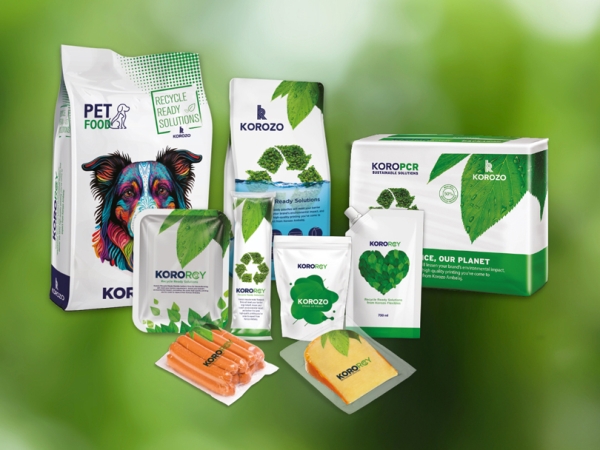
At Korozo Group, we frame compliance as an opportunity rather than a disruption. Our transition to packaging structures addressing evolving regulatory and sustainability requirements has been ongoing for many years, driven by responsibility to the planet. Our mono-material MDO-PE solutions for food and non-food applications give us practical experience of this transition.
Innovation and sustainability in tandem
Innovation and sustainability are now part of the same conversation. Often viewed as competing disciplines and then spoken about in parallel, for forward-thinking flexible packaging business, today innovation and sustainability are topics that have converged and are now the same conversation.
Production-ready materials, machinery configurations and process improvements are now aligned and designed to meet regulatory deadlines without sacrificing performance. Mono-material PE- and PP-based structures capable of replacing complex laminates while maintaining barrier properties and shelf-life performance have received significant attention.
Achieving improved recyclability, increased use of circular materials and strong barrier performance within a single substrate is the defining technical challenge of this period and the industry is meeting it with real engineering effort. Korozo's KoroRCY MDO-PE laminating film contributes directly to this, enabling high-barrier pouch solutions designed for recycling.
The use of more than 30% post-consumer recycled (PCR) content for non-contact-sensitive packaging is the next major industry threshold, and one we are already working to commercialise. Films with around 10% PCR for contact-sensitive applications are also entering the market. Regulatory baselines require 35% and 10% respectively by 2030, rising to 50% and 25% by 2040.
The next generation of flexible packaging
The future is now and sustainable and circular flexible packaging is already a commercial reality.
Machinery suppliers have updated their lines to handle structures designed for recycling and have improved runnability and processability, addressing a persistent concern for brands: whether sustainable formats can perform in production at required speeds. The answer that question today is yes, provided the right materials, machine settings and supply chain relationships are in place.
Smart packaging developments point to what comes next. Digital product passports, QR codes, NFC integration and real-time carbon footprint tracking are tools that can enable packaging to act increasingly as a data carrier. AI-driven prototyping tools are accelerating the design cycle, helping brands move from concept to compliant structure more quickly.
Structures developed in accordance with recognised design-for-recycling principles and validated through converter, raw material and machinery partnerships are freely available, with branded, market-ready formats to be seen up and down grocery store aisles.
This is not tomorrow’s packaging, it is packaging available right now.
Sustainability in practice
The language of intent has been replaced by the language of compliance and capability.
Circular Economy solutions that have matured rapidly with machinery capable of switching between conventional polymers and next-generation structures without sacrificing line speed. This has removed one of the last remaining commercial objections to sustainable format adoption.
For brands and retailers, the message is straightforward: For many applications, the technical solutions needed to support the transition are already available. Materials, machinery and structures designed to address evolving recyclability requirements are increasingly being validated for commercial use. The materials exist. The machinery is configured. The structures have been validated for shelf performance. What is needed now is the willingness to act and the right supply chain partnerships to do so with confidence.
Korozo Group has long operated with this mindset. Packaging structures designed to support recyclability and circularity are not an emerging part of our portfolio; they are an established focus of our innovation and development activities.
Partnerships that deliver success
Meaningful progress requires collaboration across the entire value chain and the industry understands this.
The most compelling examples are not from companies working in isolation. They are the result of deliberate partnerships between raw material suppliers, converters, machinery manufacturers and brand owners. A systematic approach to sustainability is needed: coordinated, integrated and designed as a whole.
The mono-material pouch developed in collaboration with spout producer Menshen demonstrates what is possible when converter and component supplier work together from the outset. Our ongoing work with Pöppelmann reflects the same approach. The partnership we have with Windmoeller & Hoelscher illustrates what end-to-end supply chain alignment can achieve.
When a structure is developed collaboratively, validated on the right machinery and presented to brand owners with the relevant technical and compliance documentation, it stops being an option and becomes a commercially viable solution.
The flexible packaging industry is undergoing significant transformation. Regulatory deadlines are arriving, and materials and machinery are ready.
What will separate the brands and retailers that succeed is the quality of the partnerships they build and the speed with which they act on them.
The industry is actively working to deliver this level of collaboration. We are proud to be doing our part to support this and foster strong relationships and support the transition towards a more resource-efficient and circular packaging system.